Since the publication of Hernando de Soto’s landmark book The Mystery of Capital in 2000, the link between property rights and economic development, especially for the world’s poor, has become...
The media has the responsibility to provide society with objective, accurate, and timely information of economic trends and events, however incomprehensible jargon is regularly used in news reports without an...
Strong, well-informed think tanks strengthen democratic governance in ways that simply can’t be replicated by other advocacy groups. Economic think tanks are indispensable to CIPE, as they explain the benefits...
Understanding of property rights often remains limited to property titles, without deeper appreciation of the underlying and interconnected institutions that make property rights meaningful and allow property markets to function....
Good governance is essential to creating business associations that are independent and mission-driven, can grow a broad membership base, can be responsible financial stewards, provide membership services, and effectively represent...
Public-private dialogue strengthens policymaking by incorporating valuable private input and creating momentum for reform. For dialogue to be most productive, the private sector must take initiative to advocate for its...
Introduction The Middle East and North Africa (MENA) region is experiencing rapid private sector growth. While each country is unique, visionary companies throughout the region embrace improved corporate governance as...
Introduction Corruption occurs in all societies, but threatens the economic and political fortunes of developing countries the most. Bribery, conflicts of interest, and illegal deals impose heavy costs on the...
The participation of the private sector in the fight against corruption is key to success. The most effective anti-corruption programs engage the private sector in institutional reforms that promote competitive...
In this in-depth analysis written by Larry Diamond, he touches on the necessary checks and balances that are essential to monitor, constrain, expose, and punish the abuse of power within...
As China enjoys extraordinary economic growth and showcases exceptional resilience during the worst financial crisis in decades, observers nevertheless note that the country continues to suffer from a number of...
Abstract Since 2004, the Center for International Private Enterprise (CIPE) has worked with the Institute for Solidarity in Asia (ISA) to develop and promote ISA’s performance governance system (PGS) as...
Strategies for Policy Reform, Volume 2 reveals how local reformers in partnership with the Center for International Private Enterprise (CIPE) have transformed policy dialogue in their countries to create a...
Article at a glance The traditional approach to studying economic growth overlooks the importance of individuals and individual firms. Market economies are not monolithic – there are four different types...
Introduction: The Linkages between Corporate Governance and Development Successful development efforts demand a holistic approach, in which various programs and strategies are recognized for their important contributions to progress and...
In order to capture the potential of the dramatic increase in the youth population, new policies need to be developed in an inclusive manner. Today’s youth are tomorrow’s business leaders...
Tearing down barriers to market entry opens routes to formality and creates new opportunities for both the informal sector as well as the poor. The Center for International Private Enterprise’s...
This detailed review provides insight into the work done by Hernando de Soto’s Institute for Liberty and Democracy (ILD), which identified and promoted the crucial elements of growth that had...
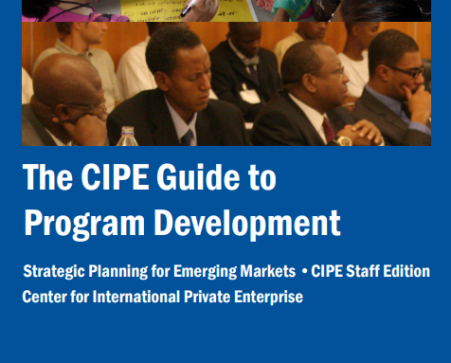
The CIPE Guide to Program Development introduces techniques and principles that are essential to the development of robust reform agendas. This guide explains how CIPE assists private sector citizens in...
For democracy to deliver, reform efforts must focus on improving economic institutions as well as political structures. Many of the fragile democracies exhibit governments that are seldom accountable to their...