CIPE Publications

230 Items
|
View1020
||

Governing Trusted Supply Chains: Public-Private Coordination in an Era of Geoeconomic Competition 

Guides & Tools
The global economy is undergoing a structural transformation in which geopolitical considerations increasingly shape trade, investment, and technology flows. The era in which economic interdependence was assumed to generate political stability has given way to a more contested environment, characterized by strategic competition, selective decoupling, and the active use of economic instruments for security purposes....

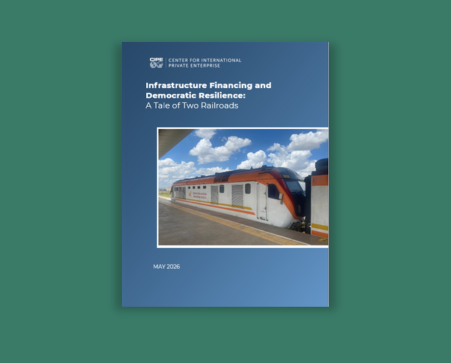
Infrastructure Financing and Democratic Resilience: A Tale of Two Railroads

Case Studies
This paper examines two flagship BRI rail projects—the Kenya Standard Gauge Railway (SGR) and the Addis Ababa–Djibouti Railway (AADR)—to assess how differences in transparency, civic oversight, and media environments shape both economic outcomes and political legitimacy. Despite similar scale, cost, and timing, the two projects have acquired starkly different public reputations. The Kenyan project has been mired in controversy and litigation, while the Ethiopian project has attracted comparatively little public scrutiny. This divergence reflects not fundamental differences in project quality, but contrasting civic and institutional contexts.

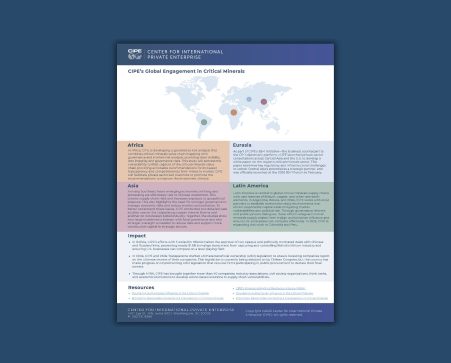
Safeguarding Critical Minerals Supply Chains From Authoritarian Capture

Flyer
Critical minerals such as lithium, cobalt, tungsten, and rare earth elements are foundational to U.S. national and economic security. These minerals power vital industries including healthcare and electronics, while underpinning advanced defense systems and next-generation technologies. As global demand for minerals accelerates, control over the extraction, processing, and supply of these resources has become a...

Assessment of Samoa’s Investment Security Landscape

Articles
Samoa is a small island developing state with a GDP of approximately USD 850 million and a population of 205,557. The economy depends heavily on remittances, tourism, agriculture, and foreign aid, with the tertiary sector now accounting for over 80 per cent of GDP. The formal private sector is dominated by micro and small enterprises,...

Safeguarding Economic Sovereignty in Solomon Islands

Articles
This report examines the governance architecture of Solomon Islands through the lens of economic sovereignty. Commissioned under the Center for International Private Enterprise (CIPE) initiative on safeguarding economic sovereignty in Pacific Island countries, it aligns with CIPE’s corrosive capital framework to assess how lawful capital can distort markets, weaken institutions, and undermine long-term national wealth...

CIPE Builds Business Resilience, Trust, and Growth in Central Asia

Articles
A delayed bank transfer. Unexpected documentation requests. A logistics partner suddenly asking pointed questions. For entrepreneurs across Central Asia, these aren't random inconveniences: they signal of a shift in how business operates. CIPE is helping these businesses comply and compete in the global economy.

The Role of AI in Association Management in Developing and Emerging Markets

Surveys
Artificial Intelligence (AI) technologies are viewed overwhelmingly as a source of opportunity for associations in developing and emerging markets. Rates of adoption are significant, yet usage remains an evolving story. Bullish attitudes toward AI have not yet been converted to the level of member benefit. There is a tremendous need for upskilling within associations to...

Mitigating Corrosive Capital & Attracting Constructive Capital: A Practitioner’s Guide

Guides & Tools
For years, CIPE has studied the effects of foreign investment on economies and governments around the world, documenting the many ways investments undermine or support market and democratic institutions in recipient countries, as well as identifying actions to strengthen economic resilience. This led CIPE to develop the twin concepts of Corrosive Capital® and Constructive Capital...

Driving Transparency in Cambodia: How Lenders Shape Infrastructure Standards

Guides & Tools
Governments in emerging economies are turning to a variety of sources for infrastructure funding and technology. Among the avenues for countries in Asia and the Pacific: multilateral development banks and donor agreements with neighboring countries such as China, Japan, and South Korea. To show how differently lenders from the three countries operate, CIPE and its...
230 Items
|
View1020
||