
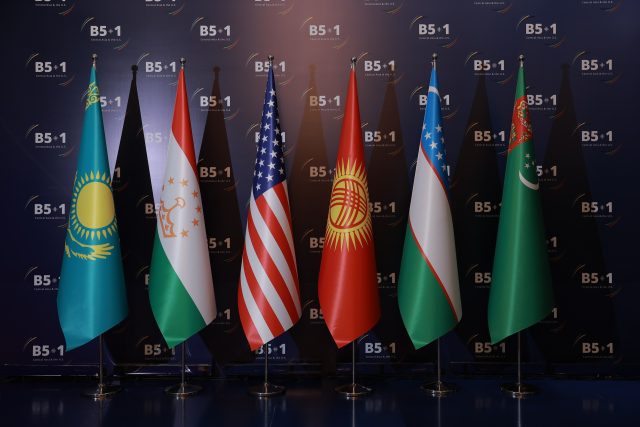
 The second B5+1 Forum officially opened in Bishkek, Kyrgyz Republic, marking the continuation of a growing regional platform for public-private dialogue and economic cooperation. Building on the success of the inaugural Forum held in Almaty in 2024, Day One focused on progress achieved through the B5+1 process and advancing practical policy solutions to strengthen regional economic integration and U.S.–Central Asia commercial ties.
Hosted by the Government of the Kyrgyz Republic and convened by the Center for International Private Enterprise (CIPE) under its IBECA program, funded by the U.S. Department of State, the two-day Forum brings together business leaders, policymakers, and experts to translate private-sector priorities into actionable reforms. Day One featured high-level welcome remarks, keynote interventions, a plenary panel, and multiple breakout public-private dialogue sessions focused on critical minerals, agriculture, tourism, and finance and banking.
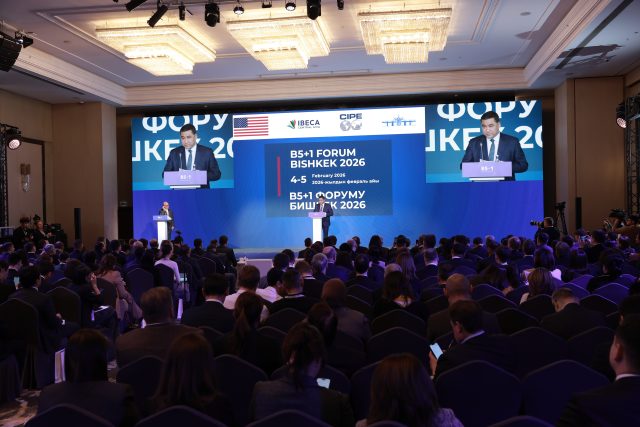
Opening remarks underscored the importance of sustained regional cooperation and inclusive dialogue. Speakers emphasized the B5+1’s role as a new way of partnership that aligns national reforms with regional priorities and creates a stronger, more attractive investment environment across Central Asia. The full program and speaker list, as well as regional business agendas are available on the B5+1 website.
Below is a summary of the key discussions and sessions from Day One.
B5+1: From Almaty to Bishkek
The Forum opened with reflections on the evolution of the B5+1 platform since the Almaty Forum. CIPE representatives highlighted the year-round work of sector-specific Task Forces, extensive consultations with businesses across the region, and the development of Regional Business Agendas that form the foundation for policy engagement at the Forum.
A keynote address on Central Asia–U.S. business connectivity by CIPE’s Chairman Greg Lebedev reinforced the strategic importance of the region and the value of deepening commercial ties through predictable regulations, improved connectivity, and public-private collaboration.
Panel Discussion: B5+1 on Critical Minerals
A plenary panel focused on critical minerals as a strategic sector for Central Asia–U.S. cooperation. Panelists highlighted priorities such as modernizing geological data, improving fiscal incentives for exploration, harmonizing customs and transit procedures along the Trans-Caspian International Transport Route, strengthening human capital, and ensuring legal stability and transparency.
The session emphasized actionable steps governments and the private sector can take over the next 12–24 months to strengthen the region’s role in global critical minerals supply chains.
Breakout Public-Private Dialogues
Day One featured three parallel breakout dialogue sessions designed to advance implementation of the Regional Business Agendas through structured public-private engagement.
Agriculture Regional Business Agenda
Participants discussed reforms to strengthen agricultural trade and supply chains, focusing on digitalization, harmonized standards and certification, and export growth through quality and sustainability. Speakers highlighted the importance of coordinated regional approaches to improve market access and expand U.S.–Central Asia agricultural trade.
Tourism Regional Business Agenda
The tourism session explored how Central Asia can position itself as a unified destination in global markets. Discussions focused on joint marketing, harmonized service standards, workforce development, simplified border procedures, and improved transport connectivity to support seamless multi-country travel.
Finance and Banking Regional Business Agenda
The finance and banking dialogue addressed digital integration, international compliance standards, capital market development, and managing risks related to international sanctions. Panelists emphasized the importance of regulatory clarity, regional coordination, and stronger links to international financial systems to facilitate investment and trade.
Across all breakout sessions, participants engaged in open dialogue, shared practical experiences, and identified concrete policy actions and commitments to be reflected in the 2026 B5+1 Final Communiqué.
Day Two will continue with additional panel discussions focused on broadening international partnerships and expanding trade flows.
For more updates on CIPE social media accounts:
Published Date: February 04, 2026