
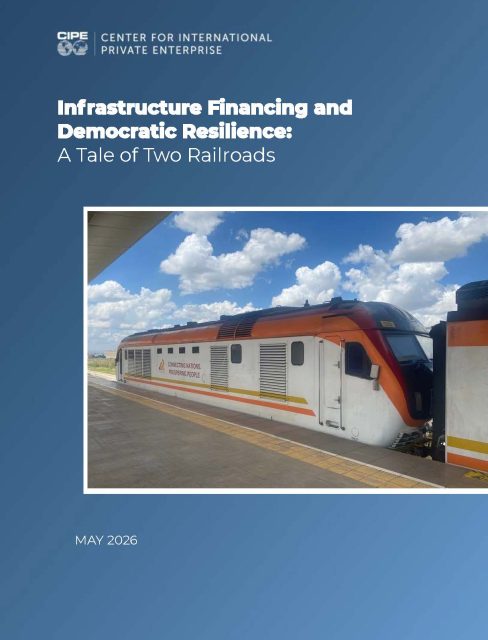
 Large-scale infrastructure investments are central to economic development strategies across Africa, yet the long-term economic and governance outcomes of these projects depend as much on how they are financed and managed as on their technical delivery. Chinese financing under the Belt and Road Initiative (BRI) has enabled governments to undertake capital-intensive projects that might otherwise have remained unfunded. At the same time, the governance structures surrounding many of these investments have exposed recipient countries to fiscal risk, weakened democratic accountability, and eroded public trust.
This paper examines two flagship BRI rail projects—the Kenya Standard Gauge Railway (SGR) and the Addis Ababa–Djibouti Railway (AADR)—to assess how differences in transparency, civic oversight, and media environments shape both economic outcomes and political legitimacy. Despite similar scale, cost, and timing, the two projects have acquired starkly different public reputations. The Kenyan project has been mired in controversy and litigation, while the Ethiopian project has attracted comparatively little public scrutiny. This divergence reflects not fundamental differences in project quality, but contrasting civic and institutional contexts.
Published Date: May 18, 2026