Transcript
This transcript was generated automatically and may contain errors.
Michele Crymes:
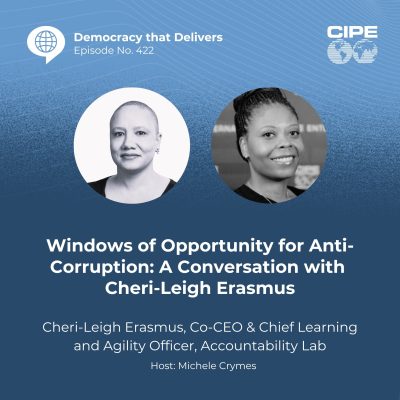
Welcome to the podcast, everyone. My name is Michele Crymes, and I’m the program director for CIPE’s Anti-Corruption and Governance Team. I’m really excited to have a guest with us today who has been working extensively on rapid response and on maintaining democratic gains during moments of political change.
I’m happy to introduce Cheri-Leigh Erasmus. She is the co-CEO and chief learning and agility officer at Accountability Lab. Cheri, thank you so much for joining us. We’re really glad to have you here.
Cheri-Leigh Erasmus:
Thanks for having me, Michele. I’m really looking forward to this conversation.
Michele Crymes:
To give our listeners some context, at CIPE’s Anti-Corruption and Governance Program we work on a range of projects focused on transparency and accountability. One area we focus on is what we call “windows of opportunity.” These are moments of democratic shift — when countries experience political transitions, government crises, or reform momentum that creates openings for civil society and reformers to move democracy forward.
These windows are often short-lived and chaotic, but they also present unique opportunities for transparency and accountability. Through our rapid response initiative, we collaborate with civil society partners, reformers, and the private sector to respond quickly during these moments. The goal is to sustain democratic progress and advance anti-corruption and transparency reforms before the window closes.
Cheri, I’ve given a bit of an overview, but I’d love for you to share an example of a window of opportunity you’ve seen recently so listeners have a concrete sense of what we’re talking about.
Cheri-Leigh Erasmus:
Absolutely. When I think about recent windows of opportunity, Nepal really stands out. In 2024, young Nepalis — particularly Gen Z — took to the streets in large numbers. They were frustrated with corruption, entrenched political elites, and a governance system that didn’t feel designed to include them.
That protest energy contributed to a major political shift. Elections were held in March, and there is now a new, young prime minister in power. On paper, that’s clearly a window of opportunity: new leadership, strong public appetite for change, and a genuine sense of possibility.
But what we also saw was that civil society organizations in Nepal were already stretched thin. Many were facing funding shortfalls, staff fatigue, and the cumulative strain of operating in a difficult environment. So even as the window opened, the organizations best positioned to push for reform weren’t always resourced to act as effectively as they could have been.
That gap between the political moment and civil society’s readiness is something we need to be honest about. As Gen Z–led protests continue to drive political shifts globally, we’re likely to see more of these windows open. There’s real urgency in making sure civil society organizations are equipped to play their role when that happens.
Michele Crymes:
You touched on the difficult environments many organizations are operating in, which is something we see constantly in our work. I’d love for you to expand on what civil society brings to these moments — and where the biggest challenges tend to be.
Cheri-Leigh Erasmus:
At the heart of it, civil society’s greatest strength during these moments is legitimacy rooted in relationships. Established civil society organizations have spent years building trust with communities, especially those often excluded from governance decisions. At the same time, many also work with insiders in government who are genuinely trying to reform the system.
That kind of trust can’t be built overnight. Organizations that show up during moments of reform aren’t parachuting in — they know the terrain, they understand who the real reformers are, and they can read the political context accurately.
The challenge is structural. Most funding models aren’t designed for speed. Grant cycles are annual, reporting requirements pull senior staff away from strategy, and readiness for a window of opportunity doesn’t fit neatly into project-based funding. In an ideal world, organizations would have the resources to activate their strengths the moment a window opens. Instead, people often push forward anyway — but at great personal and organizational cost.
Michele Crymes:
That established trust is something we see as essential to rapid response and reform movements. One thing we’re trying to think through is how organizations stay prepared despite these structural constraints.
I also want to talk about coordination. Our work shows that progress often requires bringing together actors who don’t usually sit in the same room. Have you seen examples where coordination across civil society — and eventually with the private sector — has worked well?
Cheri-Leigh Erasmus:
Coordination works best when relationships are built before a window opens. The places where I’ve seen successful coordination are those where actors already had trust, shared values, and some understanding of how to work together.
By the time a political crisis hits, it’s too late to start building trust from scratch. Effective coordination doesn’t always require formal structures. Often it’s about a small group of trusted actors who can convene quickly, share information honestly, and make decisions without getting stuck in process.
It also helps to have clarity on roles ahead of time — who’s strong on communications, who can convene, who has flexible financial resources. That shared understanding makes it possible to act quickly when it matters most.
Michele Crymes:
That’s incredibly helpful and aligns closely with how we’re thinking about rapid response — especially the work that needs to happen before a window opens.
I want to shift to resilience. You’ve worked closely on Civil Strength Partners, which supports organizations adapting to increasingly challenging environments. Can you tell us a bit about why initiatives like this are needed?
Cheri-Leigh Erasmus:
Civil Strength Partners emerged from data we collected at Accountability Lab during the funding crisis. We gathered self-reported data from about 1,200 organizations globally and saw that many had extremely short funding runways. Around 60 percent reported having six months or less of funding, and many were already laying off staff or furloughing teams.
This led us to conclude that organizations may need to rethink how they’re structured — through mergers, strategic partnerships, or shared services — to survive and stay impactful. Civil society organizations are being asked to do more, in harder conditions, with less stability than at almost any point in recent memory.
CSP supports organizations through these transformations, from early exploration to full mergers or even dignified wind-downs. We also help fund the expertise — legal, financial, organizational — that leaders often can’t afford but desperately need. The goal is sustainability, because ultimately this ecosystem is interconnected.
Michele Crymes:
That idea of bringing organizations together really resonates. I’m also thinking about the role of the private sector. Beyond funding, where do you see opportunities for private sector engagement?
Cheri-Leigh Erasmus:
Funding isn’t the only resource the private sector can offer. Expertise, partnerships, and joint advocacy all matter. Civil society plays a critical role in creating an enabling environment for business — monitoring procurement, pushing for transparency, and holding governments accountable.
Often that work is invisible until it disappears. When civil society weakens, corruption risks increase, compliance becomes harder, and businesses feel the impact in their supply chains and bottom lines. There’s a real opportunity right now for deeper conversations between civil society and business leaders about what’s at stake and how we can work together.
Michele Crymes:
I couldn’t agree more. We’re hoping to intensify those conversations — bringing civil society and private sector actors together to think through solutions and collaborative initiatives.
Cheri-Leigh Erasmus:
That’s exactly what creates effective coordination during windows of opportunity. Relationships, trust, and shared understanding have to be built in advance. I’m really excited by this initiative because it’s much needed.
Michele Crymes:
Before we wrap up, I want to ask one final question. What gives you hope as you think about the future of anti-corruption, transparency, and democratic reform?
Cheri-Leigh Erasmus:
What gives me hope is that we’re not just in a moment of crisis management. I’ve been thinking a lot about the concept of “polytunity” — the idea that alongside a polycrisis, we’re also facing a generational opening.
The old operating system is failing so visibly that we’re allowed to imagine replacing it. This isn’t a moment for marginal reform — the instability at the center creates space to be imaginative, to build new relationships, and to rethink how we work together.
Civil society, the private sector, and reform coalitions each hold a piece of the puzzle. When those pieces come together during specific windows of opportunity, the collective impact is far greater than what any one group can achieve alone. I really hope we don’t miss this moment to redesign how we collaborate.
Michele Crymes:
I couldn’t agree more. Thank you so much for sharing your perspective, Cheri. It’s been a great conversation, and we’re really looking forward to continuing this work together. Thanks to everyone for joining us today.
Cheri-Leigh Erasmus:
Thank you.