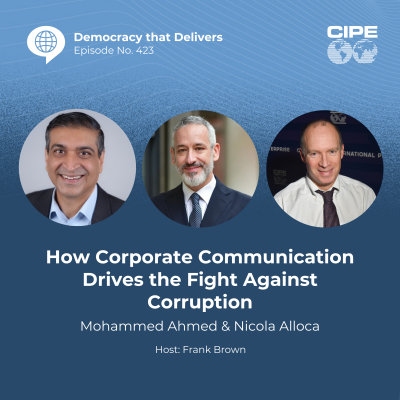
Trasncript
Frank Brown: Hello, everyone. My name is Frank Brown, and I lead the Anti-Corruption and Governance Practice at the Center for International Private Enterprise, or CIPE, here in Washington, D.C. This episode is part of our Rapid Response series, where we explore practical solutions to corruption challenges.
Today, we’re focusing on corporate responses to corruption in an increasingly complex and volatile global environment, especially through communication and culture. I’m joined by two outstanding guests.
Nicola, let’s start with you. Please introduce yourself.
Nicola Allocca: Thank you, Frank. It’s a pleasure to be here. I’m an executive professor and entrepreneur working on governance, integrity, and AI. Over the past 25 years, I’ve worked in the private sector on governance and business integrity, often in complex environments.
I currently chair the Integrity and Anti-Corruption Committee at Business at OECD, and I previously co-chaired the B20 Integrity and Compliance Task Force. I also teach Responsible Business Conduct at the University of Rome Tor Vergata and contribute to international programs on anti-corruption, risk management, and AI governance.
Much of my recent work focuses on how artificial intelligence is reshaping compliance, performance, and decision-making.
Frank Brown: Thank you, Nicola. Mohammed, could you introduce yourself as well?
Mohammed Ahmed: Of course. Hello, Frank, and Nicola. I’m the Global Anti-Corruption and Financial Crime Compliance Leader at Deloitte Global. I oversee compliance programs covering anti-corruption, anti-money laundering, sanctions, and export controls.
I’m also vice chair of the Integrity and Anti-Corruption Committee at Business at OECD and serve on CIPE’s board. This conversation brings together two areas I’m deeply engaged in, so I’m excited to be here.
Frank Brown: This discussion coincides with the release of a new policy paper: Talk Integrity: How Corporate Communication Drives the Fight Against Corruption. Nicola, could you briefly explain the role of Business at OECD and the committee?
Nicola Allocca: The OECD is an international organization where governments develop global standards and solutions to shared challenges — and corruption is one of the most significant.
The OECD Anti-Bribery Convention, introduced in 1997, remains one of the most important global instruments in fighting corruption. Today, it binds 46 countries.
Business at OECD represents the business voice within this system, bringing together more than 10 million companies worldwide. Our committee focuses on integrity, governance, and responsible business conduct, while also anticipating emerging trends such as AI, communication, and education.
In today’s volatile and complex environment, integrity is no longer just a compliance issue — it’s a strategic business priority tied to trust, resilience, and credibility.
Frank Brown: Nicola, why is this policy paper especially relevant now?
Nicola Allocca: Many companies already have strong compliance systems, but behavior doesn’t always change — and that’s the real challenge.
The paper is built around five key ideas: moving from rules to behavior; moving from fear-based communication to positive storytelling; practicality through real examples; simplification of complex standards; and embedding integrity into culture.
Ultimately, the goal is not more policies, but stronger cultures.
Frank Brown: Mohammed, Deloitte is featured in the paper. Can you explain the “Dilemma” training approach?
Mohammed Ahmed: Dilemma is a TV-style ethics and compliance training program delivered in short episodes. It presents realistic scenarios that our professionals face, including corruption-related challenges.
It was designed to move away from traditional, static e-learning and instead use storytelling to drive engagement.
Frank Brown: Nicola, what are the key takeaways for organizations?
Nicola Allocca: Communication is a governance asset; integrity must move into daily practice; communication must be tailored; approaches must be scalable; and integrity is linked to trust, innovation, and resilience.
Frank Brown: Mohammed, what happens when companies don’t take a holistic approach?
Mohammed Ahmed: While focusing on communication is important, an organization’s program may not be effective if it does not have the requisite focus on other elements such as monitoring and due diligence. Even with those elements in place, the program may not be effective without a strong ethical culture. Integrity as a North Star is critical
Frank Brown: Nicola, how is compliance evolving — especially with AI?
Nicola Allocca: Compliance now requires communication skills, systems thinking, and AI literacy. AI can enhance monitoring and training but must be used responsibly.
Frank Brown: Mohammed, what guidance does the paper offer SMEs?
Mohammed Ahmed: Each of the case studies in the paper includes a set of principles that can be adapted by SMEs. These case studies illustrate some tactical strategies that can be very valuable to SME’s related to audience, messenger, delivery method, and frequency of communications.
Frank Brown: Nicola, what’s next?
Nicola Allocca: The future is simplification — smarter governance, reduced complexity, and using AI to improve compliance and performance.
Frank Brown: Thank you both for joining us.
End of transcript