
As geopolitical competition intensifies and supply chain vulnerabilities come into sharper focus, the question of how democratic partners can work together to protect and strengthen their economies has never been more urgent.
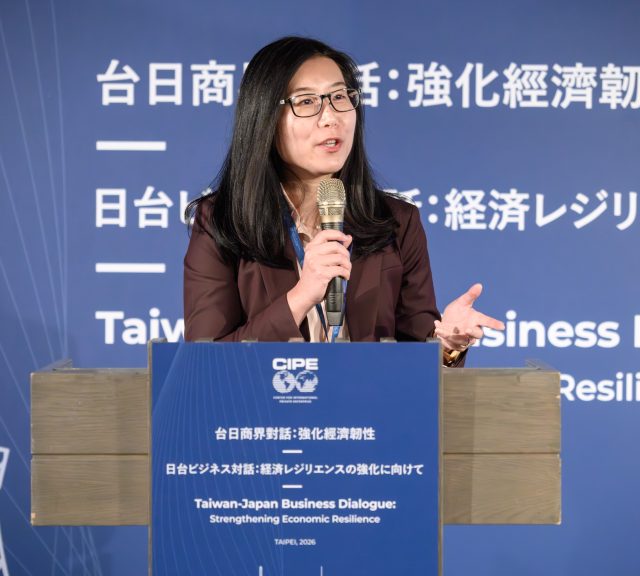
On January 14, 2026, the Center for International Private Enterprise (CIPE) convened the Taiwan-Japan Roundtable on Economic Resilience in Taipei — bringing together senior government officials, private sector leaders, think tank representatives, and business associations from Taiwan, Japan, and the United States to chart a path forward.
About the Event
Rising geopolitical tensions have prompted policymakers to call for greater de-risking from China, amid concerns that trade, market access, and supply-chain dependencies could be used as leverage for economic coercion. At the same time, many businesses continue to rely on the Chinese market and highly efficient manufacturing networks, making it difficult to align de-risking policy goals with the practical realities of supply-chain diversification.
Taiwan, Japan, South Korea, and other democratic partners are placing greater emphasis on economic resilience, more diversified supply chains, and stronger public-private coordination. For businesses, this is not only a geopolitical issue, but also a practical risk-management challenge tied to continuity, competitiveness, and long-term market stability.
The roundtable focused on three core objectives:
- Addressing the growing need for economic resilience as a component of national security
- Identifying ways for Japan, Taiwan, and the United States to build complementary supply chains to reduce supply-chain risks
- Highlighting the importance of public-private and whole-of-society cooperation to sustain economic resilience policies
Featured Speakers
- Catherine Tai, Director, China in the World, CIPE — Opening Remarks
- Vincent Chao, Deputy Secretary-General, Taiwan’s National Security Council
- Katayama Kazuyuki, Representative, Japan-Taiwan Exchange Association, Taipei Office
- Karin M. Lang, Acting Director, American Institute in Taiwan
Discussion Summary
Economic Resilience as a Core Element of National Security
Participants emphasized that economic resilience must now be treated as a core component of national security. Recent global conflicts and rising geopolitical tensions demonstrate that economic systems — including finance, energy, cybersecurity, and high-tech supply chains — are directly implicated in national security planning.
Participants noted the importance of shifting from crisis management to crisis prevention. Strengthening coordination across government agencies, improving planning frameworks, and ensuring a unified approach to economic security were identified as key priorities. At the same time, maintaining open markets and fair trade remains essential to sustaining economic growth while enhancing resilience.
Supply Chain Security Requires Public-Private Coordination
Participants highlighted that supply-chain security requires not only government action, but also sustained engagement from the private sector. While governments can establish regulatory frameworks and strategic direction, firms play a central role in implementing resilience through their operational and investment decisions.
Participants stressed that preparation is more effective than recovery. Firms were encouraged to build internal resilience by strengthening emergency response capabilities, investing in workforce preparedness, and ensuring continuity of operations under disrupted conditions. Embedding resilience into company culture and leadership structures can enable firms to operate effectively even in extreme scenarios, including when communications or infrastructure are compromised.
Complementary Strengths of Taiwan, Japan, and the United States

Participants highlighted Taiwan’s role as a global leader in semiconductor manufacturing, Japan’s strengths in materials and industrial systems, and the United States’s leadership in innovation and advanced technologies. Together, these capabilities can support the development of more secure and diversified supply chains.
The discussion emphasized a shift from cost-driven supply chains toward integrated, trust-based ecosystems. These ecosystems enable the flow of technology, standards, and talent among like-minded partners, creating more resilient and adaptable networks. Taiwan, Japan, and the United States were frequently described as forming a core Indo-Pacific economic partnership.
Managing Strategic Risks from Overdependence on China
Participants emphasized that economic resilience is not divorced from growth. Rather than disengaging from global markets, the focus should be on diversification and risk management. Democratic economies, taken together, possess significant economic capacity; the challenge lies in coordinating efforts to redesign supply chains for long-term stability.
Participants outlined steps firms can take to mitigate risk, including mapping supply-chain exposure, identifying single points of failure, investing in alternative suppliers, and incorporating geopolitical risk into board-level decision making. Strengthening rule of law, protecting intellectual property, and ensuring regulatory predictability were also highlighted as important elements of a resilient economic environment.
Resilience as a Competitive Advantage
Participants emphasized that resilience could serve as a competitive advantage, not only a defensive measure. Firms that invest in resilient supply chains and operational preparedness are better positioned to navigate uncertainty and maintain competitiveness during disruptions.
Looking Ahead
The roundtable underscored that economic resilience is no longer a secondary concern, but a central pillar of national security and economic strategy in the Indo-Pacific. Participants emphasized that achieving resilience will require sustained coordination across governments, businesses, and civil society, as well as deeper cooperation among like-minded partners. Taiwan, Japan, and the United States are well positioned to lead these efforts by leveraging their complementary strengths and shared commitment to open and secure economic systems.
Ultimately, resilience was framed not as a static goal, but as an ongoing process. By embedding resilience into policy frameworks, corporate strategies, and international partnerships, stakeholders can better navigate an evolving geopolitical landscape while promoting stability, growth, and competitiveness.
About CIPE: The Center for International Private Enterprise (CIPE) strengthens democracy around the globe through private enterprise and market-oriented reform. Learn more at cipe.org.