
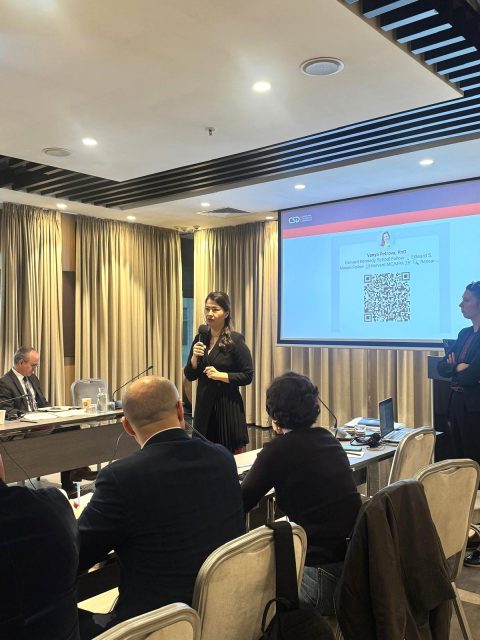
On May 12–13, CIPE and the Center for the Study of Democracy (CSD) convened a high-level training in Chișinău to strengthen Moldova’s economic resilience and investment climate against illicit financial flows and malign economic influence.
About the Event
 The training prioritized three strategic outcomes in support of national and regional stability:
Identifying Economic Vulnerabilities. Participants strengthened their ability to detect trade-based money laundering, shell companies, sanctions circumvention, and opaque ownership structures tied to corrosive capital.
Developing Policy Responses. Through Moldova-specific case studies on trade misinvoicing, strategic investment screening, and dual-use goods, participants developed recommendations to address governance gaps and protect critical sectors.
Mobilizing Private Sector Leadership. The training reinforced the role of business associations, think tanks, and private-sector actors in advancing transparency, responsible investment, and democratic resilience.
Participants and Speakers
The event opened with remarks by Elizabeth Lawrence, acting deputy chief of mission at the U.S. Embassy in Moldova, and Oleg Bivol, state secretary at the Ministry of Economic Development and Digitalization of Moldova, both of whom underscored the urgency of strengthening economic governance amid evolving regional security challenges.
Eric Hontz of CIPE’s Accountable Investment practice, alongside Dr. Tihomira Kostova and Dr. Vanya Petrova, senior analysts at CSD, led sessions on illicit financial flows, corrosive capital, sanctions circumvention, and investment screening.
Participants represented a cross-section of Moldova’s public and private sectors, including the Ministry of Economic Development and Digitalization, Invest Moldova, the Public Services Agency, the Moldova Banks Association, AmCham Moldova, the Foreign Investors Association, and leading SME and policy organizations.
Impact
By strengthening Moldova’s capacity to counter illicit financial flows and corrosive capital, this initiative contributes to broader regional stability, transparent markets, and secure investment environments across Eastern Europe — and supports U.S. and transatlantic interests in reducing vulnerabilities to malign economic influence in strategically important markets.